Japan E-commerce Fulfillment: How Can an Overseas Company Fulfill Orders in Japan?
Selling in Japan requires more than a warehouse. The seller needs a workable structure for import,
customs, tax, 3PL operations, domestic delivery, daily operations management, customer support and after-sales operations.
A Japanese subsidiary is not always the first prerequisite.
Start by defining the Japan-side operating roles, then select the warehouse, delivery and system model that fits the product and sales plan.
No Japanese Subsidiary? Start with the Operating Structure
A Japan fulfillment model can often be evaluated before establishing a Japanese subsidiary.
The key is to define who sells the goods, who imports them, who handles customs and tax procedures,
who operates the warehouse and domestic delivery flow, who manages the recurring daily operation, and who supports customers after the sale.
These roles are separate. A Japan warehouse or logistics provider does not automatically become the importer,
customs representative, Tax Agent or seller. Depending on the overseas seller's activities in Japan, foreign-company registration
or other Japan-side legal or tax requirements may also apply.
Role
Main Function
Key Point
Seller / Merchant
Sells the goods to the customer under the applicable commercial model and gives the commercial instructions.
Identify which entity is the seller or merchant for the Japan customer transaction. This may be the overseas company, its Japan entity, a distributor / reseller or another agreed commercial party.
Importer
Acts as the party responsible for importing the goods into Japan for the actual transaction.
The importer remains the responsible party for the import, including applicable customs duties and import consumption tax, even when other parties handle customs procedures on its behalf.
Attorney for Customs Procedures (ACP)
Acts in Japan on behalf of a person living abroad for specified customs procedures where required.
The ACP represents the overseas party for customs procedures but does not become the importer merely by acting as ACP.
Licensed Customs Broker
Handles import declarations, customs clearance and related customs procedures within its licensed scope.
The customs broker performs the customs work on behalf of the importer or other authorized party; it does not become the importer merely by filing the declaration.
Tax Agent
Handles required Japan tax procedures on behalf of a foreign taxpayer where applicable.
Appointment as a Tax Agent does not by itself authorize the person to provide professional tax advice.
Certified Public Tax Accountant (CPTA)
Provides tax representation, preparation of tax documents and tax consultation within the legally permitted scope.
Professional tax advice should be arranged separately with an appropriately qualified professional where required.
Japan 3PL
Receives, stores, fulfills and ships inventory, and performs agreed after-sales logistics work.
Its warehouse role does not automatically include daily operations management or customer support, or determine importer, customs or tax responsibilities.
Daily Operations Management
Coordinates and monitors the recurring fulfillment operation, including inbound information, order flow, inventory status, shipment results, tracking data and operational exceptions.
A system connection does not eliminate the need for daily operational ownership. Define who monitors the data flow, resolves exceptions and coordinates the seller, 3PL, carriers and other service providers.
Customer Support / After-Sales Support
Handles customer inquiries, delivery issues, returns, exchanges, refunds, product defects and other post-purchase communication for Japan customers.
The seller should define who provides Japan-facing support and how issues are escalated to the 3PL, carrier, marketplace or other service providers.
How do the roles connect in a typical Overseas Seller / Non-Resident model?
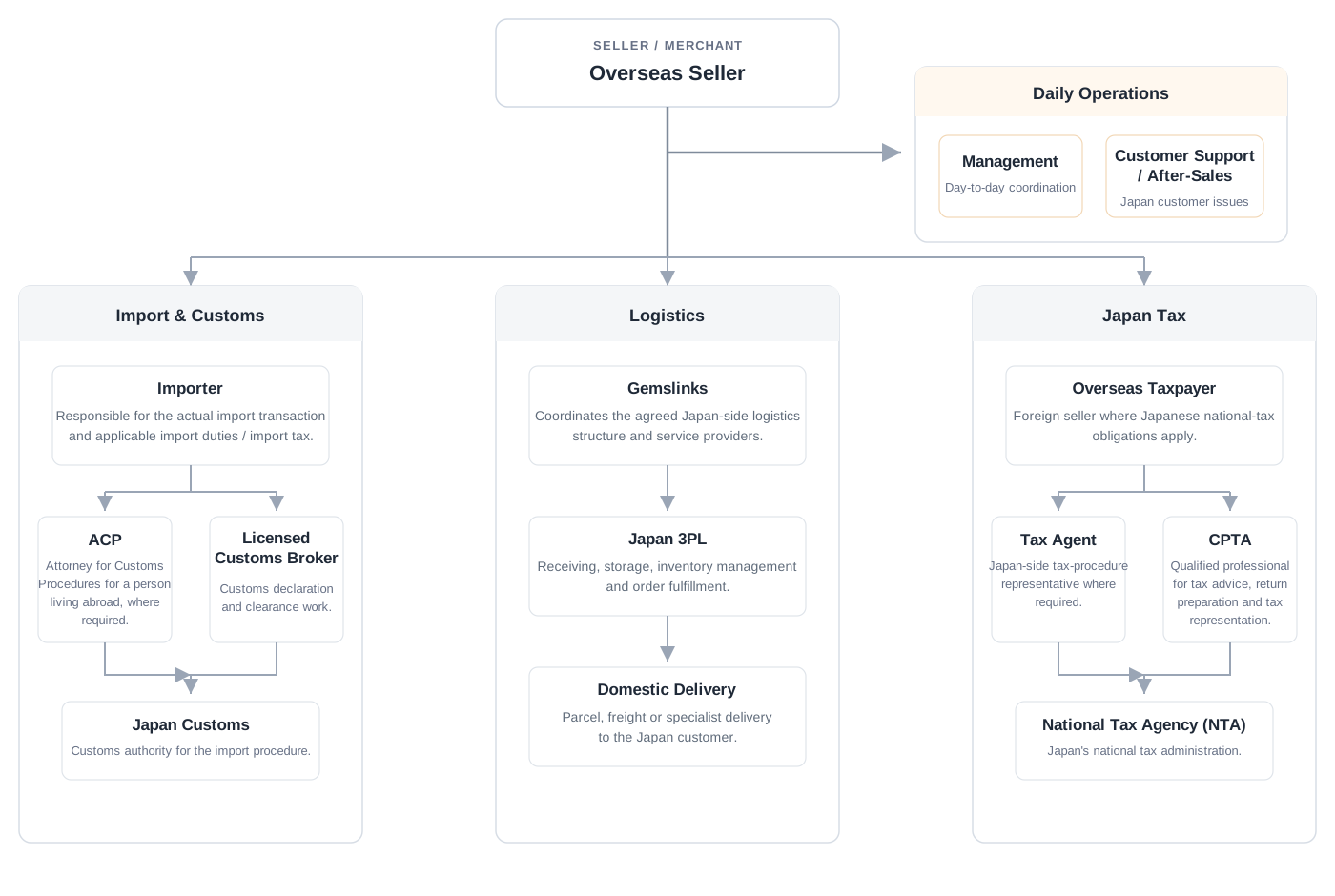
In this model, the overseas company remains the seller / merchant while Japan-side import, logistics, tax and daily operational responsibilities are assigned separately.
Daily Operations is shown as a direct operating function of the seller because ongoing management and customer support / after-sales responsibility must be assigned even when the underlying logistics and specialist functions are outsourced.
The diagram below is illustrative only: not every project requires every role, and the exact structure depends on the transaction and the seller's activities in Japan.
Typical structure only. Not every project requires every role, and the exact arrangement depends on the transaction and the seller's activities in Japan.
Daily Operations connects the seller to the recurring Japan operation
Daily Operations covers ongoing management and customer support / after-sales ownership. Import & Customs, Logistics and Japan Tax remain separate specialist functions. ACP and licensed customs brokerage are separate roles, and Tax Agent and CPTA are also different functions, although the same tax-accounting firm may cover both where appropriately appointed and qualified.
What does “Operating Model” mean?
The roles above describe the functions that need to be assigned. The operating model describes the basic commercial structure behind the Japan sales operation — in particular, which entity sells to the end customer and how that seller / merchant role is organized.
The categories below are practical planning categories used in this guide, not legal classifications.
Operating Model
Typical Seller / Merchant
How the Model Works
Key Distinction
Overseas Seller / Non-Resident
Overseas company
The overseas company remains the seller to Japan customers without operating the sales activity through its own established Japan entity. Japan-side providers may support import, 3PL, delivery and other functions as separately arranged.
The overseas company remains the commercial seller. Using Japan-side logistics providers does not by itself make those providers the seller or merchant.
Local Entity — Established / Planned
Seller's Japan entity
The seller uses, or plans to establish, its own Japan entity as part of the local commercial and operating structure. That entity may become the local seller / merchant and contract with Japan-side service providers.
The seller's own corporate group controls the local selling entity rather than relying on a third party to act as the merchant.
Distributor / Reseller
Local distributor / reseller
A local distributor or reseller typically purchases the products, or otherwise takes commercial responsibility for the resale, and then sells them onward to Japan customers under its own commercial arrangement.
This is a wholesale / resale model. The distributor or reseller becomes the commercial buyer and onward seller, rather than the overseas company selling directly to the Japan customer.
Hybrid / Other
Depends on channel or structure
More than one model is used, for example when the company sells directly through one channel, uses its own Japan entity for another, and works with a distributor for a different product line.
The seller / merchant and other operating roles should be mapped separately for each channel, product line or transaction structure.
Operating model does not automatically determine every role
The selected model identifies the basic commercial structure, but it does not by itself determine the importer, customs, tax, 3PL, daily-operations management or customer-support structure. These responsibilities still need to be confirmed separately for the actual operation.
How can the Japan 3PL be contracted?
There is no single mandatory contracting route. The practical route depends on the selected 3PL's commercial policy,
the seller / merchant structure and the Japan-side operating arrangement.
Contracting Route
Typical Structure
Practical Point
Direct 3PL Contract
Seller / Merchant → Japan 3PL
Possible where the 3PL accepts an overseas corporate customer and can support the required billing and operating setup.
Japan Logistics Partner
Seller / Merchant → Japan Logistics Partner → Japan 3PL
A Japan-based logistics provider such as Gemslinks may coordinate the local arrangement and, subject to a separate service agreement, contract with the selected 3PL within the agreed service scope.
Own Japan Structure
Seller / Merchant → Japan Entity / Registered Structure → Japan 3PL
The seller uses its own Japan-side corporate or registered operating structure as the contracting party.
Operating model and contracting route are not the same as importer, customs or tax structure
The operating model identifies the basic commercial structure, while the contracting route shows how the Japan 3PL is engaged. Importer, customs, tax and other regulated responsibilities should still be separately agreed and documented for the actual transaction.
This guide provides general information about Japan logistics and fulfillment. It does not constitute legal or tax advice or customs brokerage services.
The applicable requirements depend on the product, parties, transaction structure and activities conducted in Japan. Importer eligibility, customs arrangements,
tax matters, foreign-company registration and other regulatory requirements should be confirmed for the actual transaction with the relevant authorities and qualified or licensed professionals.
Gemslinks does not assume the role of importer, Attorney for Customs Procedures (ACP), Tax Agent, legal representative or other regulated role unless expressly agreed in writing
and legally permitted for the relevant transaction. Product-specific import, sale, labeling, safety or licensing requirements may also apply and are outside the scope of this logistics guide.
Japan E-commerce Fulfillment Guide
How Does Japan E-commerce Fulfillment Work?
Once the Japan-side operating roles are clear, build the logistics model in the order the inventory and orders actually move.
The guide below follows the practical flow from import and inbound through 3PL operations, domestic delivery, systems, daily operations management, customer support, after-sales operations and total fulfillment cost.
The objective is not simply to find a warehouse. The warehouse, delivery method, system workflow and commercial operating structure need to work together.
01
Overseas Supplier
Product manufacturing, preparation and international shipment to Japan.
02
Import & Customs
Japan-side import arrangements, customs coordination and delivery planning.
03
Japan 3PL Warehouse
Receiving, inspection, inventory registration and storage.
04
Order Fulfillment
Order data, inventory allocation, picking, packing and shipping-label processing.
05
Domestic Delivery
Handover to a parcel, freight or specialist delivery service for the final customer.
06
Customer Support & After-Sales
Japan-facing inquiries, delivery issues, returns, exchanges, refunds and product issues are handled under the agreed support and escalation flow.
Design the Logistics Chain Before Comparing Warehouses
The right 3PL depends on the product, inbound method, order profile, delivery requirements, customer-support / after-sales policy and system workflow.
01
Before Inventory Reaches the Warehouse
Import & Inbound
Commercial inventory needs a workable importer and customs structure before it can move into the recurring Japan fulfillment operation.
1
Who Imports the Inventory into Japan?
Define the role for the actual transaction
The importer should be confirmed under Japanese customs rules for the actual transaction. Where the seller is a person living abroad, the required Attorney for Customs Procedures (ACP) and licensed customs broker arrangements should also be confirmed where applicable.
Important
The Japan 3PL warehouse does not automatically become the importer, Attorney for Customs Procedures (ACP) or licensed customs broker.
Before the first inbound
Seller / commercial structure
Confirm which entity owns and sells the inventory.
Importer
Confirm importer eligibility for the actual transaction.
Customs procedures
Confirm the Attorney for Customs Procedures (ACP) and licensed customs broker structure where required.
2
How Does Inventory Reach the Japan 3PL?
The physical inbound flow
After the import and customs arrangements are completed, the inventory is delivered to the confirmed Japan 3PL under the agreed receiving instructions.
International sideSupplier + Transport + Import / Customs
Japan warehouse sideDelivery + Receiving Instructions + Inbound Booking
Typical sequence
Overseas supplier
Prepares the product and international shipment.
Import & customs
The agreed Japan-side import and customs procedure is completed.
Delivery to 3PL
The cleared cargo moves to the confirmed receiving point.
02
Inside the Japan Warehouse
3PL Operations
Once inventory reaches the warehouse, the recurring operation moves from receiving and storage to order fulfillment and shipment confirmation.
1
What Happens When Inventory Arrives at the 3PL?
Typical functions
Receiving, unloading or devanning, quantity checking, basic outer-condition inspection, inventory registration and storage.
Main cost drivers
Inbound format
Container, pallet, carton or domestic truck delivery.
Volume & SKU count
Carton count, SKU complexity and inventory-registration work.
Required work
Inspection, photos, labeling, palletizing or repacking.
Storage method
Pallet, shelf, floor, carton, CBM or another warehouse method.
2
How Are Customer Orders Fulfilled?
Typical functions
Order-data receipt, inventory allocation, picking, verification, packing where required, label processing, carrier handover and shipment / tracking-data return.
Order profile matters
Simple order1 SKU / 1 carton
vs.
Multi-piece orderSeveral SKUs or related cartons shipped together
Multi-piece orders normally require more careful inventory and shipment control.
03
Product & Last-Mile Fit
Domestic Delivery & Product Fit
A warehouse suitable for small parcels may not fit bulky, heavy, multi-carton or special-handling products.
5
Does Every Product Use the Same Fulfillment Model?
Fulfillment Type
Typical Products
Warehouse Question
Delivery Question
Standard Parcel
Apparel, accessories, small consumer goods
Can the warehouse process the required order volume efficiently?
Which parcel service and size category applies?
Multi-Carton
Furniture, equipment, product sets
Can related cartons be controlled and shipped as one order?
How are multiple pieces charged and delivered to one address?
Bulky / Heavy
Furniture, long cartons, heavy products
Can the facility safely receive, store and handle the dimensions?
Is parcel delivery possible, or is a specialist service required?
Special Handling
Fragile, liquid, chemical or regulated products
Does the 3PL have the required capability and operating rules?
Which carriers can accept the product and packing condition?
Do Not Compare Warehouse Rates Alone
Outbound labor and domestic delivery repeat every time an order ships. For bulky, heavy or multi-carton products,
delivery can have a greater impact on total fulfillment cost than the storage rate.
04
Orders, Data, Daily Operations & After-Sales
Systems, Daily Operations & Customer Support
A workable Japan e-commerce operation needs a reliable data flow, clear ownership of the recurring daily operation and a defined customer-support structure for post-purchase issues.
7
How Do Shopify or Amazon Orders Reach the Warehouse?
Do not assume that every project requires custom API development from day one.
The practical objective is reliable exchange of the data needed for inventory and fulfillment. The connection method can be selected according to the 3PL's standard functions and the seller's launch requirements.
1
Direct / Standard Integration
Use the 3PL or WMS standard connection where the sales channel is supported.
2
External OMS / Integration Service
Use an intermediate service to connect multiple marketplaces and the warehouse workflow.
3
CSV / File Exchange
A simpler startup workflow may be possible when full automation is not required immediately.
4
Custom Development
Consider individual development only when the required operation cannot be handled by standard or existing services.
Typical data to connect
Product / SKU master
Inbound information
Orders
Inventory
Shipment results
Tracking numbers
After-sales / return status where required
8
Who Manages the Daily Fulfillment Operation?
System connection and operational ownership are different
Even when the initial workflow uses CSV or a standard system connection, someone still needs to monitor inbound information, order data, inventory status, shipment results, tracking data and operational exceptions every day.
Automation does not remove daily operational ownership
Order-integration errors, stock discrepancies, shipment holds, address problems and carrier exceptions still require a defined person or provider to coordinate the seller, 3PL, carrier and other service providers.
Typical daily coordination
Inbound
Send or confirm inbound schedules, SKU information and receiving instructions.
Orders & Inventory
Monitor order flow, inventory updates and data exceptions.
Shipment Results
Confirm shipment completion, tracking data and unresolved holds.
Exceptions
Coordinate the seller, 3PL, carrier or customer-support team when operational action is required.
9
Who Handles Customer Support in Japan?
Define the customer-facing responsibility
Before launch, decide who will respond to Japan customers and in which language. Typical cases include order and delivery inquiries, address changes, delivery problems, returns, exchanges, refunds, product defects and other post-purchase questions.
The warehouse is not automatically the customer-service desk
The 3PL can provide shipment, inventory and returned-goods information within its agreed scope, but the seller should separately define who communicates with the customer and who makes commercial decisions such as refund or exchange approval.
Typical escalation flow
Customer
Raises an inquiry or reports a delivery or product issue.
Customer Support
Confirms the issue, communicates with the customer and determines the next required action under the seller's policy.
3PL / Carrier / Marketplace
Provides operational information or carries out the agreed logistics action where required.
Seller
Retains the commercial policy and decision-making responsibility unless another arrangement has been expressly agreed.
10
How Are Returns, Exchanges, Refunds and Product Issues Coordinated?
Customer decision and physical logistics are separate
The customer-support function may approve or instruct the required response under the seller's policy. The 3PL can then perform the agreed physical work, such as receiving returned goods, checking condition, taking photos, updating inventory status, holding the goods or preparing a replacement shipment.
Typical after-sales outcomes
Return
Receive and identify the returned goods under the agreed process.
Exchange / Reshipment
Prepare a replacement shipment after the required approval and inventory confirmation.
Refund
The commercial refund is handled by the seller or the relevant sales / payment channel; the 3PL provides logistics information where required.
Product Defect
Record the condition, photos or other agreed evidence and hold or process the goods according to instruction.
05
Total Operating Cost
Cost Structure
Compare the total operating model for the actual inbound volume, inventory level, order profile and delivery pattern.
11
How Are Japan Fulfillment Costs Built?
Compare the total operating model, not one attractive line item.
The useful comparison is the estimated total cost for the actual inbound volume, inventory level,
order profile and domestic delivery pattern.
Cost Group
Typical Items
Main Cost Driver
Setup / Fixed
Account setup, WMS or system charges, minimum monthly fees
Pallet, CBM, location, shelf, carton or floor storage
Inventory volume and storage method
Outbound
Order handling, picking, packing, labels, materials
Orders, lines, units and cartons per order
Domestic Delivery
Parcel, multi-piece, freight or specialist delivery
Size, weight, destination and service level
Daily Operations Management
Order and inventory monitoring, shipment-result handling, tracking, exception management and provider coordination where outsourced or agreed
Order volume, operating complexity, exception frequency and required coordination scope
Customer Support / After-Sales
Customer inquiries, delivery issues, return / exchange coordination, defect handling and related logistics work where outsourced or agreed
Support scope, inquiry volume and required after-sales actions
What should be compared between providers?
Compare setup and fixed charges, inbound handling, storage, outbound labor, packing, domestic delivery, daily operations management and customer-support / after-sales requirements together. A low rate in one category does not necessarily produce the lowest total fulfillment cost.
Gemslinks Approach
How Gemslinks Supports Japan Fulfillment
We coordinate the Japan-side logistics structure around your actual operating requirements.
Rather than starting with a single warehouse, Gemslinks first organizes the product, inbound,
fulfillment, delivery and system requirements, then coordinates the appropriate Japan-side logistics providers and operating flow.
1 — Organize the RequirementsConfirm the product, inbound volume, SKU and order profile, delivery requirements, sales channels, daily-operations ownership, customer-support / after-sales requirements and target launch timing.
2 — Define the Japan-side Logistics StructureIdentify the required 3PL, domestic delivery, customs-clearance and other logistics functions, while separating legal, tax and other regulated responsibilities where applicable.
3 — Screen & Coordinate ProvidersIdentify suitable Japan 3PL and delivery options, obtain operating conditions and quotations, and compare them based on the actual fulfillment model.
4 — Build the Operating FlowCoordinate inbound delivery, warehouse receiving, inventory, order fulfillment, domestic delivery, recurring operational data and exception handling, and the logistics-side escalation flow for customer-support and after-sales issues.
5 — Support Launch & Operational CoordinationCoordinate the initial inbound and test operation, then support adjustments to the logistics setup as inventory and order volume develop.
Gemslinks coordinates the logistics structure — regulated roles remain separate
Gemslinks does not automatically act as the importer, Attorney for Customs Procedures (ACP), licensed customs broker,
Tax Agent, Certified Public Tax Accountant or legal representative. Where such functions are required,
the appropriate structure and qualified or licensed service providers are confirmed separately for the actual transaction.
Customer support should also be assigned explicitly
Gemslinks can coordinate the logistics-side information and escalation points with the 3PL, carrier and other providers. End-customer support, commercial decisions on refunds or exchanges, and Japan-facing communication remain with the seller or the separately agreed support provider unless expressly included in the service scope.
Initial Requirements
What Information Is Needed for an Initial Fulfillment Estimate?
You do not need a perfect RFQ to start.
A first screening can usually begin with a small set of practical information.
1. Operating Model & Contracting Route
Which operating model applies — Overseas Seller / Non-Resident, Local Entity, Distributor / Reseller or Hybrid / Other — and how is the Japan 3PL expected to be contracted?
2. Import / Customs Status
Is the importer, Attorney for Customs Procedures (ACP) or licensed customs broker arrangement already known?
3. Product & SKU Count
Product type and exact or approximate number of SKUs.
4. Carton Size & Weight
Representative or SKU-level packing information.
5. Initial Inbound Volume
Container, pallet, carton count, CBM or another volume estimate.
6. Orders & Order Profile
Expected monthly orders and typical units, SKUs or cartons per customer order.
7. Sales Channels & Delivery Area
Shopify, Amazon Japan or other channels, plus Japan delivery coverage and special requirements.
8. Daily Operations / Customer Support & Launch Timing
Who will manage the recurring order, inventory, shipment and exception flow; who will handle Japan-facing customer inquiries and after-sales issues; and what are the target dates for first inbound and sales launch?
Approximate Information Is Enough for Initial Screening
Representative packing data and reasonable operating assumptions can be used to identify suitable 3PL and delivery models before every detail is finalized.
FAQ
Japan E-commerce Fulfillment: Common Questions
Can an overseas company use Japan fulfillment without establishing a Japanese subsidiary?
Potentially, yes. Establishing a Japanese subsidiary is not always required. However, depending on the seller's activities in Japan, foreign-company registration, tax registration, importer and customs arrangements or other Japan-side requirements may apply.
Can an overseas company contract directly with a Japan 3PL?
Sometimes. Some 3PLs accept overseas corporate customers directly, while others require a Japan-based contracting party, billing arrangement or operating contact. A Japan logistics partner may coordinate the local arrangement where appropriate, subject to the agreed service scope and applicable requirements.
Can the Japan 3PL also act as the importer?
Not automatically. The 3PL, importer, Attorney for Customs Procedures (ACP), licensed customs broker and Tax Agent are separate roles. A provider performing more than one role must be eligible or authorized to do so and must expressly agree to that scope.
Can Shopify or Amazon Japan orders be connected to a Japan warehouse?
Potentially. Depending on the 3PL and systems used, the workflow may use a standard WMS connection, an external OMS, API-based integration, CSV exchange or another agreed method.
Who handles customer support for Japan customers?
The seller should define who provides Japan-facing customer support before launch. This may include delivery inquiries, returns, exchanges, refunds, product defects and other post-purchase issues. The 3PL can support the logistics side within its agreed scope, but it does not automatically become the customer-service provider.
What information is needed for an initial Japan fulfillment estimate?
Start with the intended operating model and 3PL contracting route, importer / customs status, product and SKU count, carton size and weight, inbound volume, order profile, sales channels, delivery area, daily-operations ownership, customer-support / after-sales structure and launch timing.
Planning Japan Fulfillment?
Send Us Your Basic Requirements
Start with the information you already have.
Send the basic information listed above. Approximate figures are acceptable for an initial screening.
Before contacting us, please review your basic Japan-side operating structure.
Logistics figures may still be approximate, but the intended operating model, importer / customs arrangement and Japan-facing operating responsibilities should already be defined or under active arrangement. Gemslinks can then help organize the logistics requirements and identify the items that need further confirmation with the relevant service providers or qualified professionals.